Buying Heritage Guide
How copies fail: a cross craft guide to fakes
Every craft fails differently, but counterfeits fail the same: they print what should be painted, cast what should be carved, and story what should be documented.
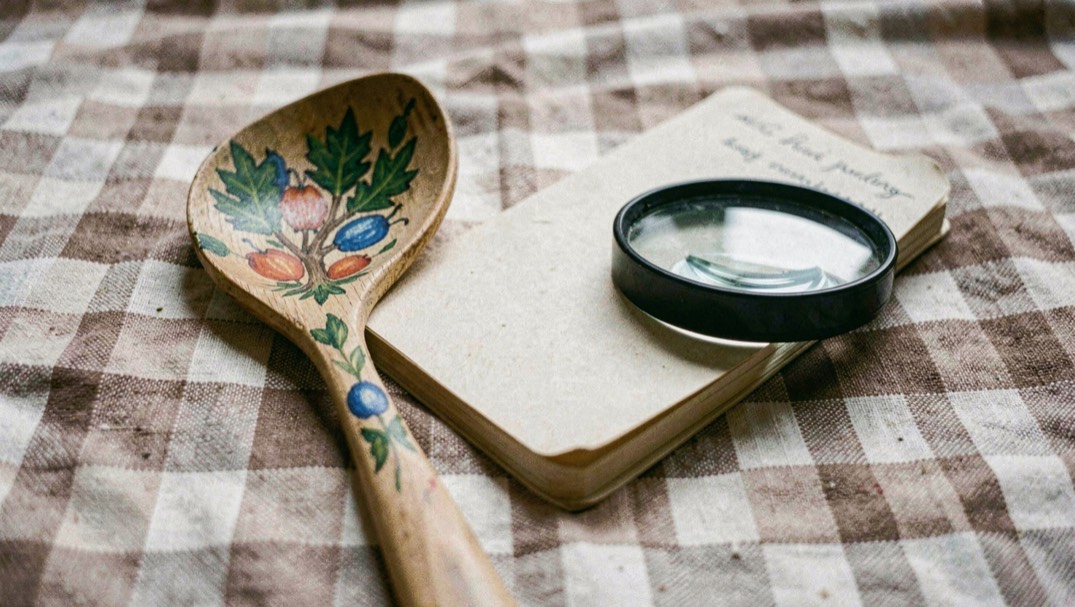
This site keeps one guide per craft, because each material betrays imitation in its own way. But spend enough time at the trays and the counterfeits start to rhyme: the same shortcuts return under every glaze and lacquer. Printing instead of painting, casting instead of carving, a story instead of a document, a price that cannot pay a hand: four failure modes cover almost everything sold dishonestly, and learning to see them once teaches the whole market.
The four failure modes
First, printed brushwork. Any craft whose value lives in the hand, khokhloma grass, Gzhel petals, Zhostovo bouquets, can be photographed, printed as a decal and lacquered. The signature of print is mechanical: under a ten power loupe the image dissolves into a regular dot lattice, and across a set the motif repeats identically, rotated but never redrawn. A brush leaves bristle edges, gradient strokes and small unrepeatable decisions; a printer leaves pixels and perfect register.
Second, cast material. Amber becomes cast plastic, carved wood becomes resin molding, hand knitted down becomes machine puff. The tells are weight, temperature and detail: cast pieces are light or unnaturally uniform, mold seams survive under the paint, and crisp hand detail, a signed base, a tapered stroke, is either absent or itself a cast of someone else’s work.
Third, the invented credential. Paper stickers naming famous towns, signatures applied in a tourist’s presence, labels printed in ornate period fonts: credentials are cheap because they work. The defense is specificity. A real signature can be compared, a real workshop has a history that catalogues record, and a real label matches a real manufactura, not a generic one.
Fourth, the impossible price. Hand work has a floor set by hours. A hand painted seven piece set offered for the price of lunch is not a bargain; it is arithmetic telling you what you are holding.
Where copies come from
It helps to know the supply behind the failures. Genuine workshops, some of them centuries old, produce limited numbers at honest speeds; demand from visitors and gift buyers vastly exceeds what hands can paint. The gap is filled by trading companies that buy blanks by the ton, decorate them by spray and decal, and sell them in the same visual language: the same towns named on stickers, the same flowers, the same gold. This is why the honest question is never whether a piece is beautiful, but who made it and how. A trading company can copy a style in weeks; it cannot copy drying times, hand fit or a kiln technique, and it never bothers to, because its buyer is not looking.
| Craft | Genuine sign | Counterfeit tell | Thirty second check |
|---|---|---|---|
| Matryoshka | Signed base, varied faces, clean seams | Sticker base, airbrush sameness, rattle | Open the first seam, read the base |
| Amber | Brine float, blue ultraviolet, resin smell | Light cast bead, no glow, acrid needle | Lift, lamp, and ask for the certificate |
| Gzhel | Gradient brushstroke, differing roses | Flat print tone, identical flowers, dots | Loupe one petal, compare two roses |
| Khokhloma | Furnace gold depth, tapering strokes | Flat yellow brown, decal dot lattice | Tilt under light, loupe one grass trail |
| Shawl | Warm wool, sharp registers, tied fringe | Slick synthetic, blurred print, glued edge | Touch the cloth, read the border |
| Miniature box | Named signature, village, title | Generic stamp, printed scene under lacquer | Turn it over, ask who painted it |
Questions that cost nothing
Recognition is mostly conversation. Where was this made, and by which workshop? Who painted it, and is the signature theirs? Is the color natural or treated, the material solid or reconstructed? Honest sellers answer with names and papers; evasive sellers answer with discounts and adjectives. The question that ends most discussions politely is the certificate one: for amber, for author miniatures, for anything priced above the table, an independent document is normal commerce, and its absence is also an answer.
Two habits protect the rest. Buy slow: the tray will still be there in an hour, and most cons work against urgency. And buy the object, not the biography: an item whose value rises as the story grows, the tsar’s pattern, the last of the workshop, the artist’s final year, is selling the one thing you cannot verify by looking.
A collector’s checklist
- Carry a loupe and a small magnet, and use both before any wallet leaves a pocket.
- Ask one specific question per craft: who, which workshop, what treatment.
- Compare pieces against each other; sameness across a set is the printer’s confession.
- Set a personal price floor for hand work and let arithmetic disqualify the impossible.
Common mistakes
- Testing only what the seller presents, when the base, the seam and the back carry the truth.
- Trusting ornate labels, which cost less than the paper they pretend to authenticate.
- Hurrying at the end of a visit, the single condition every quick sale depends on.
- Arguing instead of walking, when the four failure modes have already spoken.
The bottom line: you do not need to be an expert per craft, only literate in four failure modes. Printed against painted, cast against carved, story against document, impossible price against honest arithmetic: read those four, and almost every fake on any table convicts itself.