Amber & Jewelry
Real or fake amber: the honest tests
No single home test settles amber, but a short sequence does: brine, ultraviolet light, smell and surface, each with its known exceptions on the table.
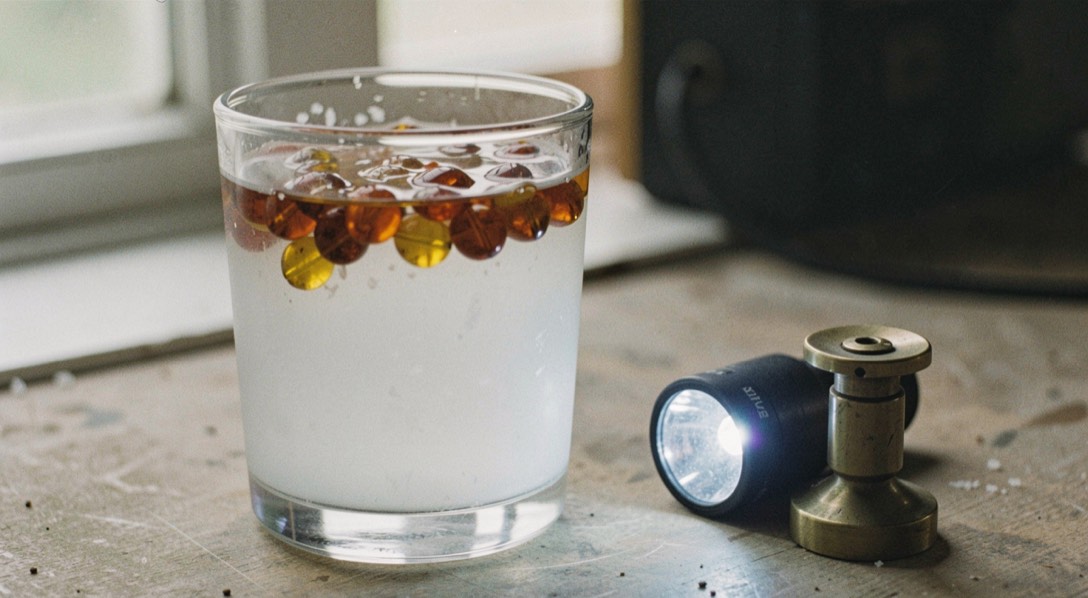
The amber trade has always run beside its counterfeit economy, and the tests that separate them are old, cheap and mostly non destructive. None of them alone is proof: pressed amber passes the float test, copal passes the ultraviolet test on a bad day, and a strung necklace fails the float test because of its clasp. Used together, in the right order, they reduce the question to two or three possibilities, which is exactly what a buyer needs before money moves.
The salt water test, done properly
The famous float test depends on density. Natural amber sits between about 1.05 and 1.10 in specific gravity, heavier than fresh water but lighter than a strong brine. Stir salt into warm water until it stops dissolving, a saturated solution; recipes circulating one part salt to ten parts water are weaker than ideal, because a thin brine sits near the boundary and lets real amber sink. In properly saturated brine, natural amber and pressed ambroid float, while most common plastics, and glass, sink.
Read the exceptions honestly. Copal, the young resin sold as young amber, can also float. A strung necklace may sink because of silk, clasps or drilled fillings, so test a single bead where possible. Rinse and dry the piece afterward; salt crystals left in drill holes are the marks of an eager tester, and they attract moisture. The test tells you what the piece is not, more reliably than what it is.
Ultraviolet light and static
A small ultraviolet flashlight, the long wave kind, changes the answer. Genuine Baltic amber fluoresces in chalky blue to pale green tones, strongest on raw or freshly polished surfaces, because of its structure and its succinic chemistry. Most plastics show no useful glow, and modern epoxy often glows a flat milky white rather than the deep cold blue of the real material. Copal can fluoresce too, which is why this test runs second, after the float, not alone.
The static test costs nothing. Rub the piece briskly on wool or silk for ten seconds and hold it to a scrap of torn paper: amber picks up the paper decisively, a trick noted in antiquity and the reason the Greek word for amber became the word for electricity. Some plastics answer weakly, so a strong response supports rather than proves. Glass, notably, does nothing.
The destructive pair: needle and solvent
Two tests are invasive and belong to pieces you own or are ready to sacrifice a hidden corner of. A needle heated at its tip, touched to a drill hole or the back of a setting, releases pine resin smoke from genuine amber, a camphor like smell from copal, and an acrid chemical sting from plastic. The mark it leaves is permanent, so choose the spot as if you will see it forever.
A cotton swab with acetone, wiped firmly on an inconspicuous area, leaves genuine amber unchanged; copal softens and turns the swab tacky, and some coated plastics lose their shine. Bakelite and other phenolic resins sink in brine and can be screened out by the float alone. Again the rule holds: one test opens a question, a sequence closes it.
| Material | Float in strong brine | Ultraviolet | Hot needle smell | Reading |
|---|---|---|---|---|
| Natural Baltic amber | Floats | Chalky blue to pale green glow | Pine resin smoke | Consistent across all tests |
| Pressed ambroid | Floats | Blue, often weaker or patchy | Resin smell, less clean | Look for flow lines and aligned bubbles |
| Copal, young resin | Usually floats | Weak blue, surface only | Camphor like, tacky under acetone | Soft, young, scratches easily |
| Phenolic resin, bakelite | Sinks | None | Formaldehyde like sting | Heavy, dense, vintage costume material |
| Modern plastic | Sinks | None or flat white | Acrid, chemical | Machine perfect, light, mold seams |
| Glass | Sinks | None | Nothing, it will not burn | Cold to the touch, hard, heavy |
When to ask for a certificate
For pieces worth real money, home tests only narrow the field. An independent gemological certificate, ideally naming succinite and succinic acid content, is the standard for high value beads and specimens, and reputable laboratories issue one page reports for modest fees. A seller confident in material welcomes the request; a seller who offers a discount instead of a document has answered a different question.
A collector’s checklist
- Start with the saturated brine, on a single bead, and note what sinks immediately.
- Follow with long wave ultraviolet in a dark room, reading the tone of the glow.
- Rub for static on wool, then weigh the evidence, never a single result.
- Reserve needle and acetone for your own pieces, in hidden spots, and photograph before.
Common mistakes
- Running the float test in weak brine, where a one to ten recipe can drown genuine amber.
- Testing a whole necklace, whose clasp and silk sink for reasons the material never chose.
- Stopping at one positive result, when pressed ambroid passes the float and copal passes the lamp.
- Burning a visible surface first, instead of spending a drill hole no one will miss.
The bottom line: the tests are a sequence, not a quiz with one question. Brine, lamp, wool, then, only if needed, smell in a hidden spot: four results that agree buy confidence, and one lucky result buys nothing.