Textiles & Shawls
Pavlovo Posad shawls: reading the painted wool
A factory town turned flowers into a language: printed wool, silk fringe and borders dense enough to read across a room.
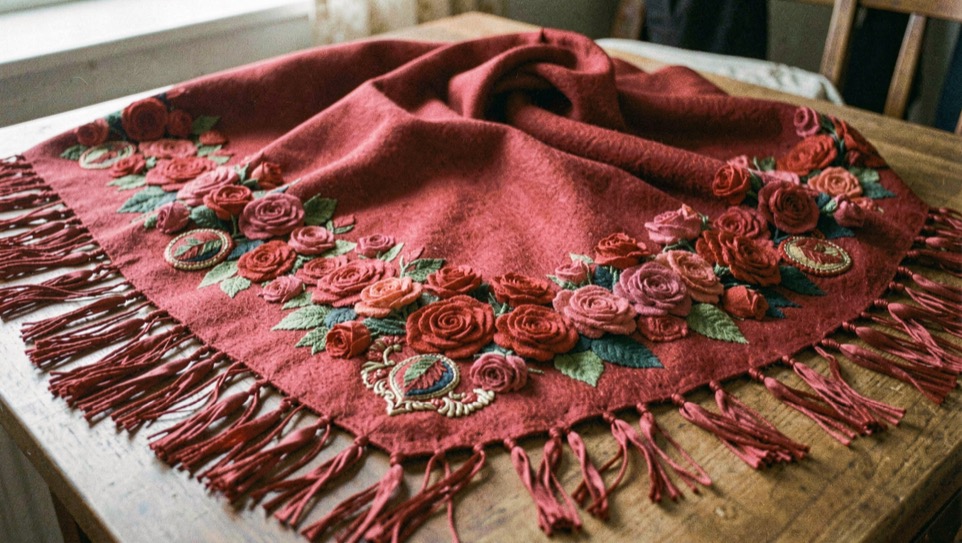
The Pavlovo Posad shawl is factory craft, and proud of it: a square of good wool printed with roses and borders so dense the shawl reads like a garden viewed from above. Its maker town east of Moscow has been in the textile trade since the 1790s, and the printed wool square became its signature in the mid nineteenth century. Because the shawl is printed, not woven or knitted, its authenticity lives in cloth, print quality and finishing, and all three can be judged with the hands.
From a weaving village to a shawl town
The enterprise that became the famous manufactura began in 1795 as a weaving establishment in the village of Vokhna, which grew into the town renamed Pavlovsky Posad in the 1840s. The firm that dominates the story, the Labzin and Gryaznov trading house, moved from woven goods into printed wool shawls in the mid nineteenth century, with full square printed shawls established from the 1860s onward. The choice proved durable: printed wool could carry bigger, bolder design than hand painted cloth, and the town became the empire’s shawl language.
Two traditions share the market and should not be confused. Woven damask shawls, where the pattern is the structure of the cloth itself, were the luxury of the earlier nineteenth century; printed shawls, pattern laid onto the surface by rollers and screens, are the Pavlovo Posad signature and the honest product of its factories, past and present. The manufactura still works, keeps an archive and a museum, and its labels are the first credential to seek.
The design language
The canonical composition solves a practical problem: a shawl worn folded must look rich at every angle. So the field carries one dominant bouquet or branch, the corners answer with medallions or horns of flowers, and a dense border frames everything, often in several registers. Roses dominate the vocabulary, with daisies, forget me nots and the occasional oriental boteh motif recalling earlier trade with the east. Colors are deep and saturated, crimson and green grounded in black or cream.
Sizes are standard and useful for identification: squares run from roughly 89 centimeters through 125 to the grand 146 or 148 centimeter full shawls, with fringe added around. The fringe itself, the silk wrapped edge, is traditionally knotted by hand, section by section, and its density and evenness are part of the quality a maker is paying for.
Reading a shawl in the hand
Wool tells first: a genuine Pavlovo Posad square is warm, slightly oily to the touch and heavy for its size, while cheap imitations in synthetic fiber feel slick and cold and smell of them when pressed with an iron at low heat, a test for owners only. Print quality tells next: modern factory printing is sharp, with saturated color carried deep into the weave, and the design registers stay aligned across the square; a blurred pattern with wandering color edges is a reprint of a reprint.
Finishing settles the rest. Labels on selvedge or corner, the hand knotted fringe with its periodic tied sections, the clean hem, and the symmetry of the layout, since a proper shawl is designed as a quarter and repeated into a whole. One sided printing is normal for the classic shawls; velvet and silk variants exist and are labeled as such.
| Feature | Genuine Pavlovo Posad | Common imitation |
|---|---|---|
| Cloth | Substantial printed wool, warm hand | Thin synthetic, slick and cold |
| Sharp registers, deep saturated color | Blurred edges, washed color | |
| Layout | Bouquet field, corner medallions, layered border | Scattered motif, thin or missing border |
| Fringe | Dense silk fringe, hand knotted sections | Sparse machine fringe or glued edge |
| Marks | Manufactura label on selvedge or corner | No label, or a generic woven tag |
| Indicative price | Roughly 60 to 300 by size and edition | A fraction of that, and it shows |
Choosing between eras and editions
The factory reissues historic patterns, and older squares surface continually at estate sales; collectors compare label styles, palette depth and fringe to date a piece, and museums of the manufactura document the editions. For a first shawl, the practical advice is unromantic: buy a current edition in full wool at the size you will actually wear or display, and hunt vintage later, when your eye is trained. The design language is stable enough that a good modern square is already a proper Pavlovo Posad.
A collector’s checklist
- Confirm the cloth first: warm, heavy wool, not a synthetic pretending to drape.
- Check print registers at the border, where misalignment confesses a poor reprint.
- Examine the fringe for hand tied sections and even density.
- Find the manufactura label and treat its absence as a price argument.
Common mistakes
- Calling every floral square a Pavlovo Posad, when the label and the layout make the name.
- Paying vintage premiums without checking print sharpness, since old reprints fade into mediocrity.
- Buying a 146 centimeter grand shawl to wear knotted, when a 89 centimeter square serves better.
- Storing wool in plastic, which holds moisture against cloth that wants to breathe.
The bottom line: the shawl is the easiest craft on this site to buy well, because the factory did the authentication work in advance. Wool, print sharpness, fringe and label: four checks, and the garden reads as intended.