Matryoshka & Dolls
A short history of the matryoshka
It looks ancient and is not: the doll was born around 1890 from a turner’s lathe, a painter’s brush and a Japanese idea, and was world famous within ten years.
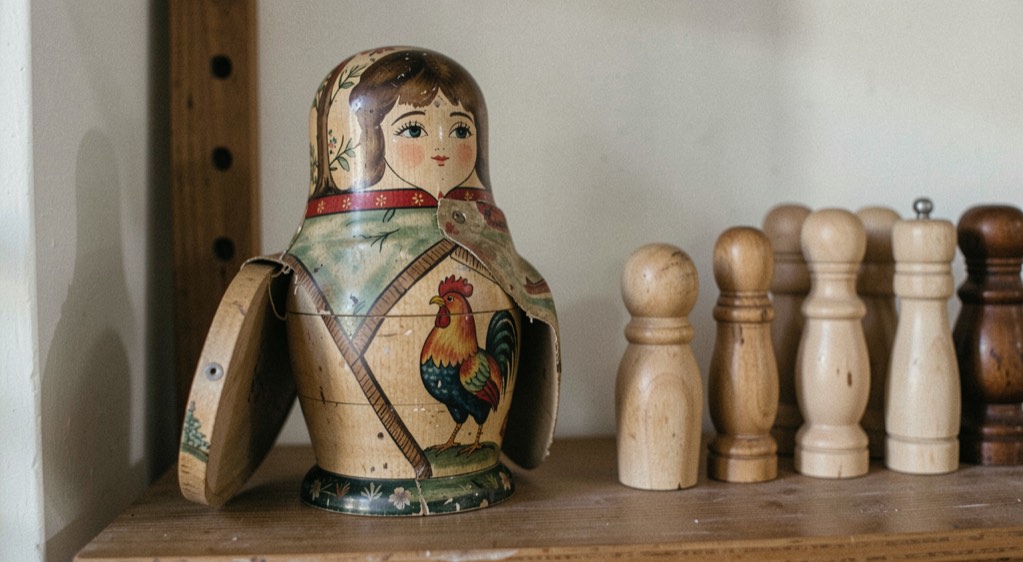
Every souvenir stall sells the nesting doll as if it had come down from the chronicles, and almost no purchase is surrounded by more confident invention. The documented history is shorter and better than the legend: a first set carved and painted around 1890, a bronze medal in Paris ten years later, and a handful of workshop towns that still define what a matryoshka should look like. Knowing the real dates is the first recognition tool, because a doll sold with a fake age is a doll sold by a story instead of a craft.
A toy born in the 1890s
The first set is credited to two people working in a toy workshop attached to the Abramtsevo estate circle, the artistic colony that did so much to revive Russian folk craft. The figures were turned by the craftsman Vasily Zvyozdochkin and painted by the artist Sergey Malyutin, the same designer whose drawing and book illustration work shaped the visual world of the period. The set held eight pieces: a girl in a sarafan and headscarf holding a black rooster, then a brother and sister alternating down to a swaddled infant last.
The shape was not invented from nothing. Early accounts connect the idea with a Japanese nesting figure, remembered under a name close to Fukuruma and said to have been brought from Honshu. What the Russian workshop changed was everything that matters: the material, the subject and the spirit. The Japanese figure was a sage; the Russian one was a family, a peasant household packed into a toy that opens like a story.
From Abramtsevo to a Paris medal
The toy moved quickly from experiment to industry. Sergiev Posad, northeast of Moscow and already a center of wooden toy making around its great monastery, took up production, and other towns followed. The decisive moment came at the Exposition Universelle in Paris in 1900, where the nesting doll won a bronze medal and found an international public. Export orders followed, and by the first years of the twentieth century the doll was already the recognizable export craft it remains.
The name itself is part of the evidence for the 1890s birth. Matryoshka is an affectionate diminutive of Matryona, once among the most common peasant names for women, and the toy carries the name of an ordinary household, not a saint or a tsar. That domestic character is exactly what early sets painted: children, milkmaids, shepherds, brides and grooms, whole processions of provincial life nested inside one another.
Early sets that were not toys at all
Before the revolution, painters also used the form for satire and portraiture: nests of political caricatures, sets portraying landowners or public figures, dolls painted as specific family members. These early subject sets are a reminder that the matryoshka began as an artist’s object with a sense of humor, not as a fixed souvenir formula. Serious collections still treat these political and portrait sets as a chapter of their own.
The form survived the end of the world it was born into. Production continued and reorganized through the Soviet decades, and the pre revolutionary workshop towns kept their identities, which is why the same toy can look so different depending on where it was made. The first surviving set is preserved today in the Toy Museum at Sergiev Posad, and seeing it documented is worth an hour of any collector’s reading.
| Milestone | Date | What the record supports |
|---|---|---|
| First documented set | around 1890 | Turned by Vasily Zvyozdochkin, painted by Sergey Malyutin, eight pieces, workshop linked to the Abramtsevo circle |
| International debut | 1900 | Bronze medal at the Exposition Universelle in Paris, followed by export production |
| Main production centers | 1900s onward | Sergiev Posad first, then Semyonov and Polkhovsky Maidan with their own styles |
| Name | 1890s | Diminutive of Matryona, a common peasant woman’s name of Latin origin, mater |
| Original set today | preserved | Held by the Toy Museum at Sergiev Posad |
What the history teaches a buyer
Three practical lessons follow from the record. First, age claims are cheap: a doll presented as hundred year old folk art is presenting a fiction, since the form barely predates 1900, so judge the object and not the story. Second, the workshop geography is real knowledge: the styles of Sergiev Posad, Semyonov and Polkhovsky Maidan are documented and distinct, and recognizing them separates an informed purchase from a lucky one.
Third, the strongest sets still show their making: turned wood, hand painting and lacquer applied by hand leave small irregularities that a factory line avoids. The history and the recognition test point the same direction, which is what a good craft always does.
A collector’s checklist
- Ask for the workshop town, and match the answer against the documented styles.
- Look at the base for a signature or studio mark, and be more suspicious of a printed sticker.
- Check the fit of the first seam: a well turned set opens with a clean, slight resistance.
- Treat any elaborate age story as decoration, and price the craft in your hands instead.
Common mistakes
- Believing an invented age, since the matryoshka is a product of the 1890s and cannot be a century older.
- Assuming the largest set in a stall is the most authentic, when piece count says nothing about quality.
- Confusing the Japanese inspiration with the origin: the idea traveled, the craft is Russian.
- Judging from photographs alone, when fit, lacquer and wood grain announce themselves in the hand.
The bottom line: the matryoshka is a young craft with a short, provable history, and that history is your first filter. A seller who respects the real story is selling a real workshop; a seller who wraps the doll in invented centuries is selling the story, not the wood.